Argentina’s University Funding Crisis Spills Into Buenos Aires Streets
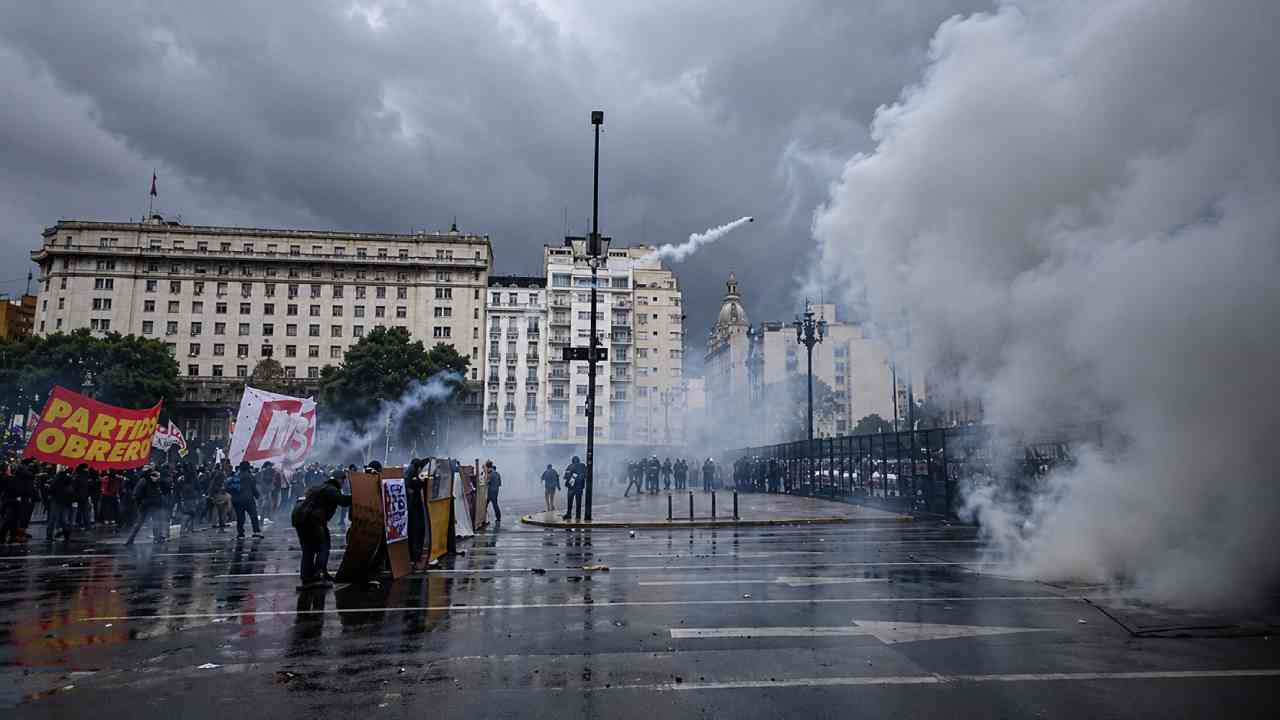
Brivify – What began as another demonstration over Argentina’s public university funding soon became a tense confrontation in central Buenos Aires. Thousands of students, professors, and supporters filled the streets, demanding that President Javier Milei’s government comply with legislation designed to strengthen university funding. The gathering was intended to be peaceful. However, tension eventually erupted near Congress. Police fired tear gas and rubber bullets as some protesters threw rocks, turning part of the capital into a chaotic scene. At least 25 people were detained, while several others were injured, including members of the security forces. Yet the confrontation represented more than another clash between demonstrators and police. Behind the anger lies a much larger question about Argentina’s future: how far can the government reduce public spending before essential institutions begin to feel the cost? For students and academics, that debate has become deeply personal.
Read Also: Mercedes C-Class Electric Review: A Quiet Cruiser With Serious Pace
Inside UBA, Students Fear Losing More Than a University Budget
Away from the clashes, another form of resistance was unfolding inside the University of Buenos Aires. Students at its Faculty of Exact and Natural Sciences announced a one-day occupation of the building. Their concerns went far beyond political slogans. Many fear that prolonged budget pressure could weaken one of Argentina’s most respected public institutions. Physics student Emiliano Gato told Al Jazeera that professors were leaving for private universities because their salaries could no longer cover basic living costs. For young researchers, that trend carries a troubling message. Universities depend not only on classrooms and buildings but also on experienced academics who teach, mentor, and conduct research. When those people leave, rebuilding expertise can take years. The protest therefore reflects anxiety about opportunities that may disappear slowly rather than overnight. Students who once imagined academic careers within Argentina’s public system are now questioning whether those paths will remain realistic.
Public Universities Have Become a Symbol of Argentina’s Austerity Debate
Argentina’s public universities now sit at the heart of a broader national argument over government spending. Since taking office in 2023, Milei has pursued an aggressive austerity programme aimed at restoring fiscal discipline. His administration has reduced subsidies, eliminated government programmes, closed ministries, and dismissed thousands of public employees. Supporters see those decisions as necessary after years of severe economic instability. Critics, however, argue that the social cost has become increasingly difficult to ignore. Education provides perhaps the clearest example because Argentina has a long tradition of tuition-free public higher education. Earlier in 2026, tens of thousands of people had already demonstrated against university cuts. Public universities have been tuition-free since 1949, giving the current dispute a cultural significance that extends beyond annual budgets. Consequently, the demonstrations are not simply about how much money universities receive. They are also about what kind of public institutions Argentina wants to preserve.
A Court Ruling Added New Pressure on Milei’s Government
The dispute intensified after Argentina’s judiciary entered the funding battle. A federal judge began imposing a daily fine of 100,000 pesos on the government for failing to implement parts of legislation covering public universities. The law requires measures including restoring university salaries and student scholarships eroded by inflation. It also calls for regular budget updates and funding for research, hospitals, and infrastructure. Congress had approved university funding legislation after overcoming presidential resistance. Milei’s government, however, argued that lawmakers had failed to identify how the additional spending would be financed. That disagreement transformed an economic debate into an institutional confrontation involving the executive branch, Congress, universities, and now the courts. For protesters, the ruling strengthened their demand that the legislation be implemented. For the administration, additional spending threatens the fiscal strategy it considers central to Argentina’s recovery. Neither side therefore views the dispute as a minor budget adjustment. Instead, both see it as part of a much larger struggle over economic priorities.
Milei Points to Falling Inflation as Evidence His Strategy Works
Despite the growing resistance, Milei continues to defend his economic programme. Inflation, once one of Argentina’s most destabilising problems, has fallen sharply under his administration. Al Jazeera reported that monthly inflation has dropped to around 2 percent, compared with the extreme levels Argentina faced when Milei entered office. The president has also argued that the country is experiencing sustained economic growth. From his perspective, maintaining fiscal discipline is essential to protecting those gains. This helps explain why the government has resisted spending commitments that it believes lack clear financing. For supporters, the logic is straightforward: Argentina cannot return to policies that could revive deficits and inflation. Nevertheless, economic improvement at the national level does not automatically remove pressure from households or public institutions. A professor struggling with living expenses experiences the economy differently from an official studying inflation figures. That contrast has become one of the defining tensions surrounding Milei’s reforms.
Read Also: Jacob Melanson Sidelined Indefinitely After Rare Chest Injury
Professors Say the Financial Pressure Is Becoming Personal
Statistics can explain Argentina’s economic transformation, but they cannot fully describe what it feels like inside a university facing financial pressure. María Teresa de Jesús, a chemistry professor at the University of Buenos Aires, told Al Jazeera that she earns roughly $700 per month and struggles to cover living expenses. She joined the demonstration despite saying that teaching and research, rather than protesting, are where she wants to spend her time. Her experience illustrates why the university dispute has gained emotional weight. When academic salaries lose purchasing power, the consequences can spread through an institution. Professors may seek private-sector work, move to private universities, reduce research activity, or leave academia entirely. Students then encounter fewer mentors and potentially weaker academic programmes. Therefore, university funding is not merely a question of maintaining buildings or paying monthly bills. It can influence whether institutions retain the people who give those institutions their reputation and expertise.
Free Higher Education Carries Deep Meaning in Argentina
Public education occupies a distinctive place in Argentine society. The country’s tuition-free university tradition has allowed generations of students to pursue higher education regardless of family income. Argentina’s public universities have also produced prominent researchers, professionals, and five Nobel laureates. That history explains why spending cuts can trigger reactions extending far beyond university campuses. For many demonstrators, defending university funding means defending social mobility itself. They worry that weakening public institutions could gradually make high-quality education more dependent on personal wealth. Government supporters see the issue differently. They argue that public services cannot remain financially sustainable without broader fiscal stability. Both concerns deserve attention because strong universities require reliable funding, while governments also need workable budgets. The difficult question is where those priorities should meet. Argentina is now confronting that question publicly, with classrooms, courtrooms, Congress, and the streets of Buenos Aires all becoming part of the same national conversation.
The Clashes Reveal a Country Divided Over the Price of Reform
The scenes outside Congress captured a deeper contradiction within Argentina’s economic experiment. Milei can point to falling inflation as evidence that dramatic reform is producing results. At the same time, students, professors, pensioners, people with disabilities, and other groups have raised concerns about what those reforms cost at the individual level. Many Argentines continue to support the president’s strategy and hope economic stability will eventually deliver stronger employment, higher wages, and better living standards. Others increasingly question whether the burden is being distributed fairly. That divide makes the university protests particularly significant. Education touches families across political and economic backgrounds, making it harder to treat the dispute as an isolated sectoral complaint. As demonstrations continue, the government faces a difficult balancing act. It wants to preserve fiscal discipline without allowing public frustration to overwhelm support for its reforms. Meanwhile, university communities are making clear that they believe education should not become collateral damage in Argentina’s economic recovery.



Post Comment