Solar Storms and the Star’s Explosion That Could Erase a Planet’s Atmosphere
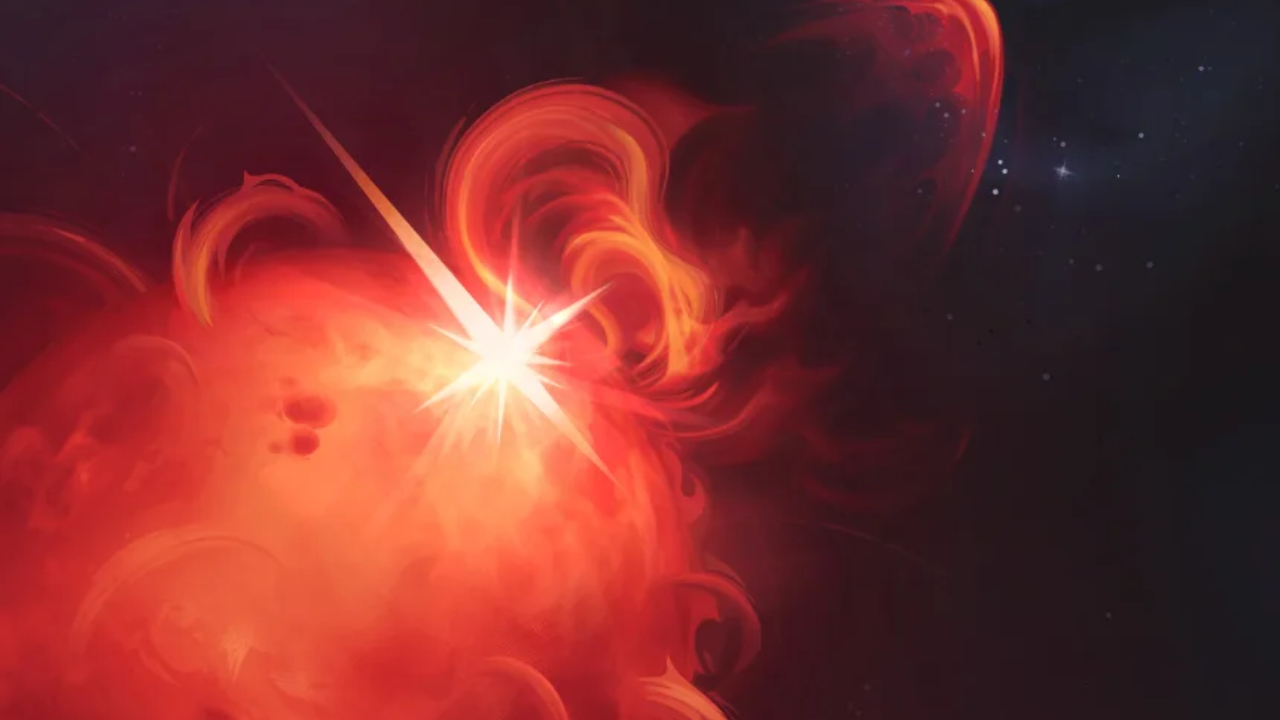
Brivify – Solar storms have always fascinated scientists because their effects reach far beyond light shows in our skies. Recently, astronomers confirmed a giant stellar explosion coming from a star outside our solar system for the first time in history. Although it resembled the Solar storms that triggered auroras on Earth last week, this event unfolded on a far more destructive scale. As someone who follows astrophysics closely, I find this moment remarkable because it reshapes the way we understand danger in the universe. Instead of creating beauty, this star’s eruption carried the power to potentially wipe out the atmosphere of any nearby planet.
“Read also: On Epstein and Venezuela, Trump Tries to Rebrand“
How a Coronal Mass Ejection Turns Deadly
At the center of this discovery is a coronal mass ejection, known as a CME. When our sun releases a CME, it can spark auroras, disrupt satellites, and interfere with electrical grids. However, when the same phenomenon occurs during a massive star’s explosion, the results become even more threatening. The CME from the red dwarf star StKM 1-1262 blasted through space at nearly 5.3 million miles per hour, a speed seen in only a tiny fraction of solar storms on the sun. With that intensity, the burst could strip away a planet’s atmosphere in moments, leaving nothing but a barren core behind.
Why Red Dwarfs Create Extreme Solar Storms
Although red dwarfs are small, they can unleash extraordinary violence. StKM 1-1262 spins twenty times faster than the sun and produces magnetic fields hundreds of times stronger. Because of this, the star behaves like a boiling sphere of unstable plasma, ready to erupt at any moment. This environment makes Solar storms far more frequent and dangerous. For me, this raises new concerns about planets that orbit such stars. Even if they sit in the “habitable zone,” the constant bombardment may make life nearly impossible.
The Radio Signal That Solved a Decade-Old Mystery
Amazingly, the data that revealed this star’s explosion had been sitting unnoticed for almost ten years in archives from the LOFAR radio telescope. With new analytic software called RIMS, astronomers finally decoded a faint type II radio burst. This signature proved that material had escaped the star’s magnetic field—a clear sign of a CME. As someone who appreciates scientific detective work, I find it inspiring that innovation in analysis, rather than new technology, unlocked this breakthrough.
How Solar Storms Shape Planetary Survival
Whenever Solar storms strike Earth, our magnetic field protects us by redirecting harmful particles. Yet even Earth’s shield might fail under the force of the CME detected from StKM 1-1262. That realization raises a difficult question: can planets orbiting active red dwarfs survive at all? Many are positioned very close to their stars, making them prime targets for atmospheric destruction. Because of that, the search for habitable worlds must now consider not just location but also stellar behavior.
“Read more: When Visa Introduced a New Era of Intelligent Commerce“
Atmospheric Loss and the Limits of Habitability
Life requires a stable atmosphere, but violent stellar activity can erase one quickly. This star’s explosion serves as a warning that even planets in perfect thermal zones may not hold onto their air. Researchers now speculate that many exoplanets near red dwarfs could become Mars-like deserts after repeated Solar storms. This realization forces scientists to rethink old assumptions about what makes a world livable.
New Telescopes and the Future of Stellar Weather Research
Fortunately, astronomy is entering a new era. The upcoming Square Kilometre Array will become the world’s most powerful radio telescope, capable of detecting faint Solar storms from stars across the Milky Way. With thousands of dishes and millions of antennae, it will map space weather in unprecedented detail. As a science observer, I can’t help but feel excited. Each new detection will refine our understanding of planetary survival and improve our estimates of how common life could be.
A Discovery That Redefines Life in the Galaxy
This first confirmed CME beyond our solar system is more than a scientific milestone. Ultimately, it changes how we imagine the galaxy’s potential for life. Solar storms are no longer just dramatic events in space—they are decisive forces that shape the destinies of worlds. This discovery shows that habitability depends as much on a star’s temperament as on the distance of a planet. For astronomers and dreamers alike, it’s a humbling reminder that the universe is both beautiful and fiercely unpredictable.